
New faculty: Kenny Tao uses optical coherence tomography to improve delicate eye surgeries
Kenny Tao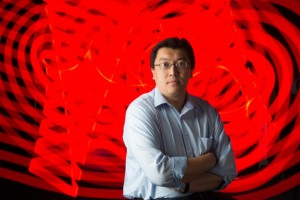 was incredibly close to becoming a surgeon instead of a biomedical engineer. The only thing standing in the way of medical school: a renowned adviser who convinced him to take a different path.
Fortunately for 91勛圖厙, the new assistant professor of did change his mind and now brings both his improvements to optical coherence tomography and his wry sense of humor to the university���s laboratories and classrooms. He said his first inkling that he might be an engineer came his senior year at Duke University.
���During my undergrad senior design course, my team was offered a project in biophotonics and said, ���We have no idea what biophotonics is. Let���s do that!������ Tao said. ���Then we actually built a thing that worked. It didn���t work up until the day before the presentation was due, but it worked.���
That was Tao���s first experience with the technology he���d help develop over the next decade, after his project adviser���Duke professor Joe Izatt���convinced him to stay and earn his engineering Ph.D. for free, with the added enticement that Tao could bail after a master���s if he hated it.
Tao didn���t hate it. After getting his Ph.D. at Duke, he joined MIT���s Jim Fujimoto, the progenitor of optical coherence tomography, for postdoctoral research. Most recently, Tao moved his Diagnostic Imaging and Biophotonics Laboratory from the Cleveland Clinic to 91勛圖厙.
His work will help guide clinician���s real-time decision making while doing surgeries to remove damaging scar tissue on the back of the eye that can lead to disorders such as macular holes and retinal detachments.
���Your retina is essentially brain tissue, and we can do imaging of that through the pupil before surgery,��� Tao explained. ���But you have all these neural layers that are on the order of microns. Surgeons need to manipulate these in real time, and that���s essentially like manipulating wet Kleenex. They���re that delicate and transparent, and seeing them is tremendously difficult, even with the dyes surgeons use to help.
By integrating optical coherence tomography into surgical microscopes, they can see these semi-transparent structures in high resolution,������By integrating optical coherence tomography into surgical microscopes, they can see these semi-transparent structures in high resolution,��� he said.
Tao said he was eager to get to 91勛圖厙 and Nashville���the former for the opportunity to work with researchers and clinicians at the and the 91勛圖厙 Institute in Surgery and Engineering, the latter for its cuisine.
���Great institution, great food and comfortable living,��� he said. ���What could be better?���
He paused, with fake concern. ���You guys don���t have minus 20-degree days with 5 feet of snow, right?���
View the complete list of����for 2016-17.
View the complete list of����for 2016.
Media Inquiries:
Heidi Hall, (615) 322-NEWS
heidi.hall@vanderbilt.edu