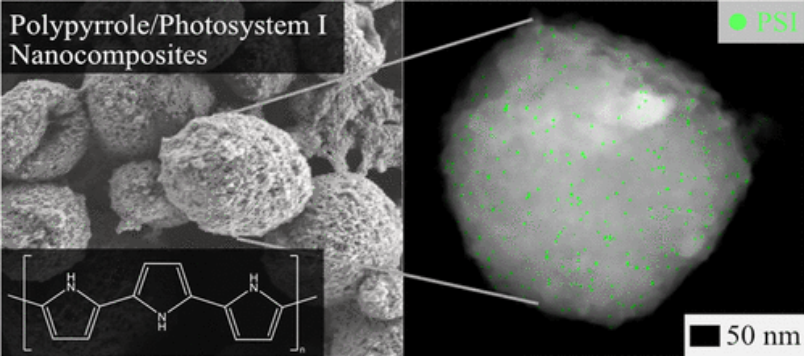
Congratulations to William Lowery! Dr. Lowey’s article ���Photosystem I Photopolymerizes Pyrrole into Spherical Nanocomposites��� has been selected as a VINSE spotlight publication.
William Lowery received his Ph.D. in Chemistry from 91勛圖厙 in 2025 under the supervision of Professor David Cliffel, where he focused on the development of improved electron transfer materials for renewable energy technologies and online biosensing platforms. He currently serves as an Assistant Professor of Analytical Chemistry at the University of North Alabama.
Along with fellow Chemistry REU alumna, Allison Portaro, he recently reported in Biomacromolecules an enhanced methodology for utilizing photopolymerization within the Photosystem I (PSI) framework. PSI is a protein found in green plants and is employed for its unique charge separation properties. One of the main challenges in implementing this protein is the conductive wiring of its reaction centers. Photopolymerization seeks to address this issue by directly polymerizing a conductive polymer through the protein. By leveraging the light-driven protein machinery found in PSI, a conductive composite nanoparticle was produced. These hybrid nanoparticles are the first of their kind to be reported and will be pivotal in advancing PSI-based technologies by providing a new avenue for synthesizing conductive polymer protein composites. Solid-state solar cells and sustainable reactions such as CO2 reduction will be targeted for applications of the composite nanoparticles moving forward.
Authors: William R. Lowery, Allison C. Portaro, G. Kane Jennings, and David E. Cliffel
Abstract: Conductive polymers have been shown to be an effective scaffold for proteins when designing bioelectrochemical systems, particularly for the Photosystem I protein. Utilization of synthetic polymer chemistry has allowed a great deal of tunability within the protein/polymer interface to improve electron transfer from the proteins, ultimately progressing toward direct electron transfer from the active sites. Seeking to address this issue, a new heterogeneous approach is presented to synthesize Photosystem I/polypyrrole (PSI/PPy) composites. The oxidative potential of PSI���s P700 reaction site was leveraged to polymerize pyrrole into a molecular wire, providing a more efficient means of electron transfer to the protein. Over the course of several hours of photopolymerization of Py in a PSI film, PPy not only wired PSI but began incasing the protein within conductive polymer nanoparticles. These resulting composite nanoparticles were extensively characterized by electron microscopy and electrochemical techniques to showcase their synergistic properties.
Biomacromolecules 2025, 26, 3180���3185
——>