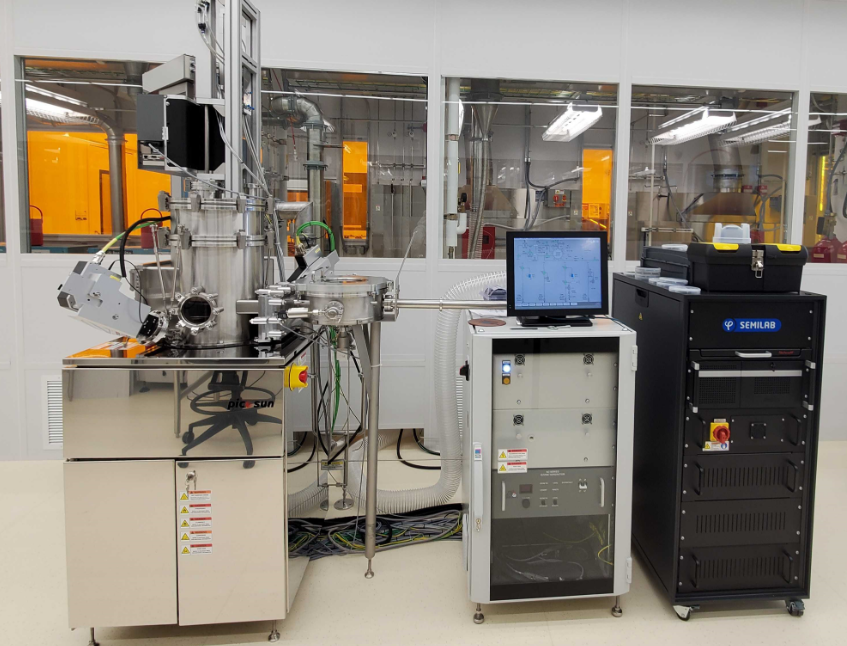
 When precise control of dielectric film thickness is required, plasma-enhanced atomic layer deposition (PE-ALD) may be a solution.�� ALD is a chemical vapor deposition technique available within the VINSE Cleanroom core facility on the Picosun R-200 Advanced tool.�� The major advantages of ALD compared to other deposition techniques are thickness control and reproducibility, uniformity, and conformality of non-planar features.
Atomic layer deposition (ALD) is performed in a vacuum reaction chamber and consists of multiple steps that make up a deposition cycle.�� Elemental components of a desired film are delivered via individual precursors with inert gas purge steps in between, and so the film growth process is self-limiting.�� As an example, common precursors used to deposit aluminum oxide (Al2O3) thin films are trimethylaluminum (Al(CH3)3, also known as TMA) and water (H2O).�� An example deposition cycle is as follows:
- Short pulse of TMA to reactor (~0.1 sec): Provides Al atoms to surface
- Nitrogen purge (~5 sec)
- Short pulse of H2O to reactor (~0.1 sec): Provides O atoms to surface
- Nitrogen purge (~5 sec)
This cycle may be repeated hundreds of times depending on thickness desired.�� Typical deposition rates are ~ 1 ��/cycle or less, and so ALD may not be practical for film thicknesses above ~1000 ��.�� Alternative techniques such as plasma-enhanced chemical vapor deposition (PECVD), sputter deposition, or electron-beam evaporation are available in the Cleanroom core.
The self-limiting nature of the ALD process is related to the reactivity of the precursors under reactor conditions.�� In a thermal deposition cycle as shown above, substrate temperature plays a critical role whether any deposition occurs (temperature too low), bulk deposition occurs (temperature too high), or the process is self-limiting (temperature within the ���ALD process window���).�� Research in the field is ongoing to develop novel precursor chemistries to shift the ALD process window based on application.�� Additionally, options for the oxygen source can provide flexibility.
VINSE currently has precursors to deposit aluminum oxide (Al2O3) and titanium dioxide (TiO2).�� Silicon dioxide (SiO2) is under development now, as well as nitrides of these materials.�� Thermal processes are typically run in the 300-450 簞C substrate temperature range, but plasma and ozone sources are also available to promote deposition at lower substrate temperatures.�� For example, the TMA-based process above can be done at 150 簞C using O2 plasma rather than H2O as the oxidant.�� This opens up the possibility for depositing conformal thin films on temperature-sensitive materials.
For more information about films that have been produced in literature, please visit the ALD Database page at .�� Please contact vinse-cleanroom@vanderbilt.edu to discuss any new material capabilities.