Zhu, Guodong., Hong, Ikjun., Li, Kewei., Anyika, Theodore., Ugwu, Maxwell T., Nolen, Joshua Ryan., He, Mingze., Caldwell, Joshua David., & Ndukaife C, Justus C. (2025).泭.泭Advanced Optical Materials. Advance online publication.泭
紼梗喧硃梭-莉硃莽梗餃泭thermal metasurfaces��are special materials designed to control how heat is emitted as light. Unlike traditional materials���such as gray-bodies, near���black bodies, or some dielectric metasurfaces���these metal-based structures keep their emission patterns stable even when temperatures change. However, they often have a major drawback: they lose a lot of energy internally through��ohmic losses, which limits their��quality (Q) factor, a measure of how sharp and selective their emission is.
This study focuses on solving that problem by finding a way to achieve both��high emissivity��(how effectively a material emits thermal radiation) and��high Q factors��in metal-based thermal emitters. The researchers use a design strategy that combines��three surface lattice resonances. These resonances support special physical effects called��bound states in the continuum泭硃紳餃泭electromagnetically induced absorption (EIA), which together allow the structure to emit light very efficiently and at very specific wavelengths.
Using simulations, the team designed a metal-based metasurface that achieves��near-unity emissivity (0.96)��and a��Q factor of 320. Experiments confirmed strong performance, showing an��emissivity of 0.82��and a��Q factor of 202���a莉棗喝喧泭five times better��than the best previously reported metal-based thermal metasurfaces.
Overall, this work demonstrates a promising way to create��efficient, narrow-band, and directional thermal emitters that maintain stable performance even across large temperature changes.
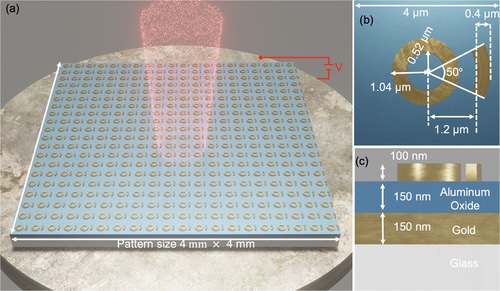
Figure 1
Schematic of the metal-insulator-metal (MIM) configuration used in the study. a) shows the schematic of the thermal metasurface for narrowband directional thermal emission. b) shows the top view of a unit cell of the metasurface comprising a complete circular gold ring and a segmented gold ring. c) shows the side view of a unit cell. A 150 nm gold reflector is thick enough to prevent optical transmission, and a 150 nm aluminum oxide spacer is used to maximize the emission.