Leonard, Kaele M.; Khalil, Timothy A.; Welch, Jacob; Dahlberg, Greta; Ratwani, Ankush; Duke, Jennifer D.; Paez, Rafael; Gordon, Elisa J.; Shojaee, Samira; Lentz, Robert J.; Maldonado, Fabien. “” Chest 167, no. 4 (2025): 1161 1170. .泭
Robotic-assisted bronchoscopy is a new, advanced method used to diagnose and treat lung nodules, and it’s become widely used in the U.S. Thanks to major funding from medical device companies, there���s been a surge in research and publications about this technology. However, there’s concern that these companies’ financial relationships with doctors could be influencing the research���and that those connections aren’t always being properly disclosed.泭
This study looked at 27 research papers published between 2016 and 2022 and analyzed financial data from the U.S. government���s Open Payments Database, which tracks money paid from medical companies to doctors. The researchers focused on 75 U.S. physician-authors who contributed to those papers.泭
In total, these doctors received about $17 million in payments from companies connected to bronchoscopy. Shockingly, $9.9 million of that���around 57%���was not reported in the articles. Out of the 75 doctors, 68 (or 91%) didn���t fully disclose their financial ties. Even when small items like meals were excluded, 60 doctors (80%) still failed to report all relevant payments.泭
The results suggest that the current system���where researchers report their own financial ties���often doesn���t work. The study recommends creating a centralized, automated system to make these disclosures more accurate and transparent.泭
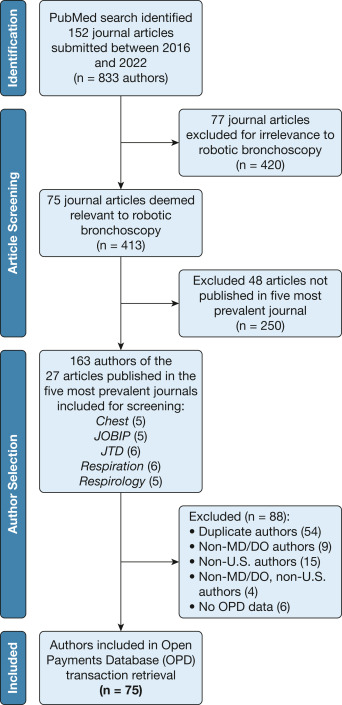
Figure 1泭泭
Author selection process. JOBIP = Journal of Bronchology and Interventional Pulmonology; JTD = Journal of Thoracic Disease; MD/DO = doctor of medicine/doctor of osteopathic medicine.泭
泭