On September 23, 2026, the 91勛圖厙 Biostatistics 2026 student award winners were announced by director of graduate studies Andrew Spieker. This year's ceremony included presentation of the first-ever MS Excellence in Biostatistics Award, established to inspire and acknowledge outstanding work performed by students in our Master of Science program. The winners of the annual faculty awards were announced by Biostatistics Graduate Student Association president Ashley Mullan.

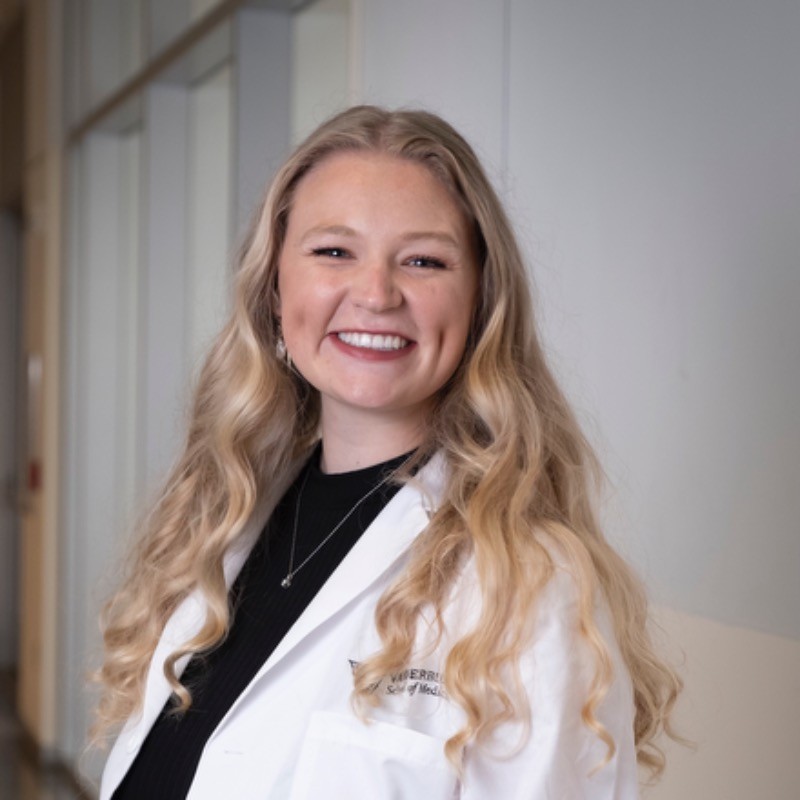

Yunbi Nam - Distinguished Teaching Assistant
for excellence in teaching and a dedication to peer education
As a teaching assistant for BIOS 6321, Clinical Trials, Yunbi provided quick turnaround on grading, helped develop rubrics for more complex assignments, and consistently gave detailed and helpful feedback. Students received clear explanations of why points were deducted and how they could improve their work moving forward. Her attention to detail and commitment to meaningful feedback supported both the instructor and student learning.
Alexis Fleming Schwartz - Commodore Award in Biostatistics
for enriching the department and/or graduate program through ingenuity, dedication, and altruism
Alexis has provided outstanding service and leadership to the Biostatistics graduate program, particularly through her role as BGSA president. She consistently brought student questions, concerns, and feedback forward and met with departmental leadership to discuss issues affecting the graduate program. Her service also extends beyond the department through involvement with an committee, an committee, and the editorial board of Child Maltreatment. She is highly organized and committed to advocating for the well-being of others while maintaining high expectations.
Zhuohui "Jeffrey" Liang - WS Gosset Award for Exceptional Research
for exemplary dissertation/thesis work or exceptional contributions to a research project/collaboration
Jeffrey���s research focuses on methodological and collaborative work at the intersection of biostatistics, artificial intelligence, and HIV research. His first dissertation paper, , introduced a latent diffusion approach for generating complex longitudinal synthetic data after existing methods proved inadequate for the structure of an HIV cohort. The resulting synthetic dataset is already being used by researchers outside the original cohort, and he is extending this work to additional datasets and methods for benchmarking longitudinal synthetic data and data augmentation. Jeffrey has presented this research at statistical and HIV conferences and, with a collaborator, received 91勛圖厙 Graduate School���s Lacy-Fischer Interdisciplinary Research Grant. He has also contributed to multiple collaborative HIV research publications (including a 2025 paper in International Journal of Infectious Diseases).


Nuo "Amber" Hu - MS Excellence in Biostatistics Award
for excellence in academics, research, professional development, and engagement within the biostatistics community
Amber was recognized for her accomplishments across academics, research, professional development, and engagement in biostatistics. Her research includes two projects in survival analysis and Alzheimer���s disease research: a review of interval-censored data methods relevant to dementia studies and an application of dynamic Cox modeling for interval-censored outcomes. Her work demonstrates an ability to engage with complex methodological literature and understand the challenges presented by longitudinal biomedical data. She is thoughtful, responsible, and intellectually curious, consistently asking careful questions and working through technically challenging material.
泭
Andrew Spieker - Golden Apple Award for Excellence in Teaching
for outstanding instruction and an altruistic commitment to student classroom learning
Students highlighted Andrew���s ability to balance theoretical concepts with practical application and explain not only how statistical methods work, but why they matter in real-world biostatistical practice. They praised his use of examples and coding demonstrations, as well as his willingness to continually update course materials and provide feedback based on student performance. Andrew was also recognized for his generous office hours, accessibility, and commitment to helping students develop both a rigorous statistical mindset and a deeper understanding of challenging concepts.
泭
Rameela Raman - Outstanding Faculty Mentor
for excellence in dissertation and thesis advising and/or dedicated mentoring with an altruistic commitment to student learning beyond the classroom
Students described Rameela as deeply invested in both the professional and personal development of her mentees. She consistently looks beyond immediate research goals and helps students identify opportunities that will support their future careers. Her mentorship includes targeted guidance as developing biostatisticians, meaningful encouragement, and support for the person behind the research. Students emphasized her dedication to helping them grow and positioning them for future success.
���
The Department of Biostatistics concurrently conducts an annual competition to recognize research and innovation excellence among its faculty and staff, and the team that won this year's Patrick G. Arbogast Collaborative Publication Award includes recent graduate (PhD 2025), first author of "" (Alzheimer's & Dementia, June 2025), with assistant professor Panpan Zhang as co-first author and associate professor Dandan Liu as corresponding author. The Arbogast Award judges commended the team for developing "The authors developed a novel double anchoring events-based sigmoidal mixed model (DSMM) and applied Bayesian methods to harmonized data from 13 longitudinal cohorts to address a long-standing question in Alzheimer���s disease research. The study established a robust sequence of cognitive decline and provides a broadly applicable framework for longitudinal disease progression research. With biostatisticians serving as the first, co-first, and corresponding authors in a high-impact clinical journal, this work demonstrates how novel biostatistical methodology can lead impactful interdisciplinary research."
Congratulations to all the winners!